We recruit qualified, graduate-level early years professionals from proven source markets — fully visa-managed, ratio-ready, and more affordable than you think.
The UK's early years staffing crisis isn't a temporary blip — and the usual routes aren't working.
You're advertising. You're paying agencies. You're interviewing people who don't show up. Meanwhile, your ratios are stretched and your existing team is burning out.
Temporary cover costs you more per day than a permanent hire costs per week — and agencies offer no retention guarantee. You're paying repeatedly for the same unfilled problem.
One unfilled role doesn't just affect operations. It puts your Ofsted compliance at risk, limits your funded places, and forces other staff into unsafe coverage positions.
The visa and sponsorship process feels complex, expensive, and uncertain. Most providers have never explored it — which is exactly why their competitors are doing it instead.
You've hired internationally before and it didn't work. No structured onboarding, no relocation support, no retention follow-up — and they were gone within six months.
From vacancy to UK arrival — we manage every stage, so you stay focused on your setting.
Early years professionals recruited under SOC code 2315 (Nursery Education Teaching Professionals) are a game-changer for settings struggling with Level 3 shortages. They're graduate-level, immediately ratio-ready, and come with government funding built in.
Level 6 equivalent — far above Level 3 — bringing classroom-trained pedagogy to your setting from day one.
Until they achieve EYTS, they're paid at the unqualified teacher pay scale — substantially lower than a qualified EYT.
Candidates have up to four years to complete their Early Years Teacher Status — no immediate pressure on your setting.
The Department for Education provides a grant of up to £14,000 toward their EYTS qualification. You get a more qualified professional — the Government helps fund their development.
Typically 4–6 months from vacancy approval to UK arrival
Confirm profiles, salary bands, timelines and visa requirements
Partner immigration lawyers guide the process; we coordinate in an early years context
Targeted advertising and networks in South Africa and Commonwealth markets
CV review and initial interviews assessing suitability, communication and cultural fit
Structured interview packs tailored to early years — EYFS, safeguarding and pedagogy
Verify education credentials, references and safeguarding expectations
Certificate of Sponsorship, visa application and full compliance documentation
Life in the UK orientation, travel, accommodation, banking and 90-day check-ins
Don't take our word for it. Here's what happened for settings just like yours.
"
We'd been short-staffed for 14 months before we spoke to TCSA. Within five months we had two ratio-ready practitioners from South Africa — better qualified than anyone we'd interviewed locally.
Nursery Manager, West Midlands · 42-place setting
"
The SOC 2315 route was something we'd never heard of. TCSA explained it clearly, managed the whole visa process, and our new hire is halfway through her EYTS — funded by the DfE grant.
Owner, South East England · Single site
"
What impressed us most was the onboarding support. They didn't just hand over a candidate and disappear. We had structured check-ins at 30, 60 and 90 days.
Operations Director · Group of 4 settings| What Matters Most to You | Level 3 (UK Hire) | SOC 2315 via TCSA |
|---|---|---|
| Available to hire in your area | ✗ | ✓ |
| Graduate-level education | ✗ | ✓ |
| Better child-to-staff ratios (1:8 for 3–4 yr olds) | ✗ | ✓ |
| Starting salary under £30,000 | ✗ | ✓ |
| £14,000 DfE grant toward training | ✗ | ✓ |
| Full visa & relocation support | ✗ | ✓ |
| Structured retention follow-up | ✗ | ✓ |
| Ratio-ready from day one | ✓ | ✓ |
Here's what agency dependency is actually costing your setting — and what international recruitment changes.
Typically 4–6 months from vacancy approval to UK arrival. This covers sponsor licence guidance (if needed), candidate attraction and screening, visa processing, and relocation planning. We'll give you a milestone plan at the start so there are no surprises.
Most settings recruiting internationally will need a Skilled Worker sponsor licence. We work with partner immigration lawyers to assess your position, guide you through the application, and ensure your ongoing sponsor duties are clearly understood.
Our fee is calculated as a percentage of annual salary, with a staged payment structure tied to milestones — you're not paying everything upfront. Replacement and refund provisions also apply if a candidate leaves early. Book a free consultation and we'll walk you through the full fee structure.
We include replacement and refund provisions within our contract. But in practice, candidates who have gone through a visa and relocation process are significantly less likely to leave than locally-hired staff. They've invested too — and we support their settlement from day one to make sure it works.
Yes. SOC 2315 candidates are classified as Nursery Education Teaching Professionals and count in your staffing ratios from the point they start work, subject to standard UK verification checks. This is a key advantage of the pathway — no waiting for qualifications to be recognised.
The DfE grant of up to £14,000 covers a significant portion of the EYTS qualification cost. Your candidate has four years to complete it, so there's no pressure to enrol immediately. We help you navigate the grant application process as part of our service.
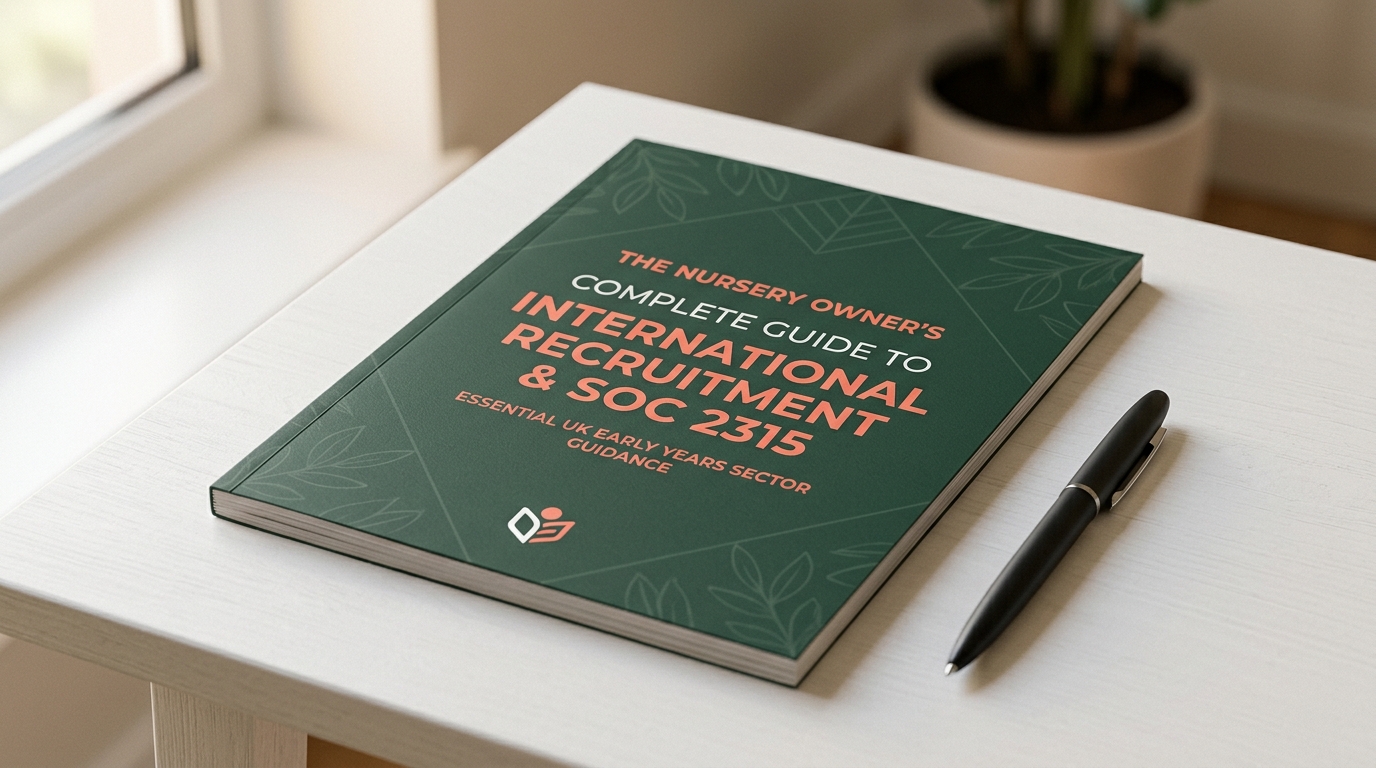
Download our free guide: 'The Nursery Owner's Complete Guide to International Recruitment & SOC 2315' — everything you need to know before your first consultation call.
No spam. Unsubscribe any time. We'll send it instantly.

The immigration code that gives nurseries access to graduate-level practitioners — with better ratios, lower costs, and Government funding built in.
Read more
How much the ongoing recruitment crisis is actually costing early years providers, and the international route that's quietly solving it for forward-thinking settings.
Read more
The difference between international hires who leave within six months and those who build long-term careers — it comes down to what happens after arrival.
Read more